
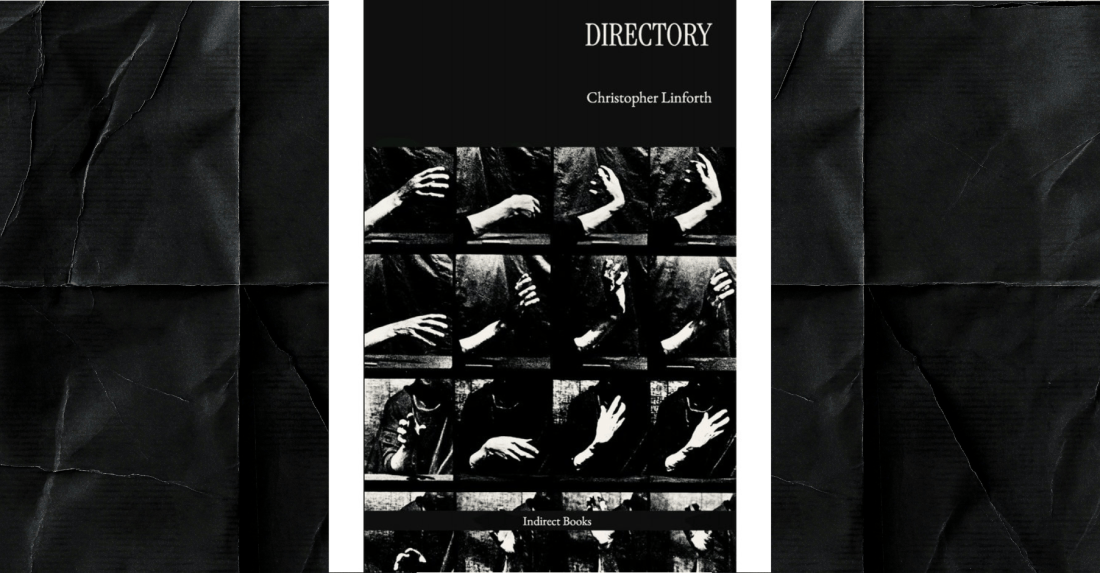
Trauma can be transformative, reshaping parts of us while other parts remain intact. It can disassociate victimization from agency and reimagine what has happened as someone else’s experience. It creates a “we” that allows us to share pain while keeping it locked inside. The we becomes a metaphor for parts of ourselves, creating tension between what one has experienced and what one becomes. Directory, Christopher Linforth’s collection of forty-one fragmented stories, captures that we in sharp, unsparing detail.
Set across different times, places, ages, and genders, Directory’s nameless characters all suffer from some form of trauma or neglect: sexual abuse, abandonment, broken family relationships, or some combination, recur across the stories. We witness controlling or abusive stepfathers, absent or distant mothers, and incidents of domestic violence that scar the characters’ childhoods and adulthoods, sometimes driving them to vengeful acts. The title story opens with, “Back when we loved our mother,” putting a neglectful parent in the past. Meanwhile, the second story, “Listing,” refers to a time as “back [when] we had names,” setting the stage for both the loss of a mother’s love and the loss of one’s identity. In “Gestalt,” two brothers “rolled along Main Street, eyeing any woman around forty. Any woman who seemed like she’d had twin boys and abandoned them.” The mother in “Procedure” refers to her children as “progeny, not children or kids or daughters,” as they wait to see the results of her X-ray to learn whether she possesses a heart.
Abuse by stepfathers is vividly described in “Recoil,” where two boys huddle in a triple bunk bed, needing a ladder “to reach the highest bunk, where a boy could scarcely fit, let alone a father.” The two sisters in “Belief” and “Tongues” thought their stepfather “knew our language. We spoke to him, pleaded with him, asked him to leave us alone.” They want to believe that “the tales of incest are false. Or possibly half-true.” In “Memes,” the memory of a father who left his family “to find himself” is remembered by “the forearm of the young woman in his Camaro — the tanned length of flesh that rested on the doorframe; the downy hair; the fingers clutching a vial of Klonopin,” as their father drove away. The father’s search for identity leads to a loss of his children’s own, evaporating into an online electric ether through which they stalk him.
Linforth’s consistent use of the first-person plural distorts the boundary between individual and collective identity. The collective we — often representing siblings — shows how trauma, codependency, and shared family history distort the boundaries of selfhood. In “Finale,” it creates a pact between twins, “a promise that we would never die without telling the other.” In “Chorus,” the we sings “in unison only for those we hate. The length of that list of people weighs on us, begs us to winnow down to those who matter,” until “the list of names now stands at two,” creating a shared self-loathing. Only toward the end of the collection is the authenticity of “we-ness” questioned, hinting that the we is really “a single person masquerading as twins . . . An individual who would never accept they were alone.”
Shifting tenses compound the distortion of past and present. Characters are frequently on the move — running away from abusive homes, traveling from place to place, or seeking lost parents. This physical movement mirrors their existential search for belonging, to know their origins, and to escape the emotional pain of their pasts. Crime and acts of violence, such as a convenience store holdup in “Pitstop,” the slaughtering of goats in “Father’s Day,” and the knifing of an abuser in “Tongues,” become rituals of self-preservation. Even the transformation of space, such as a gentrifying Brooklyn neighborhood in “The Temple,” becomes an act of violence, as displaced residents observe men entering an abandoned building “with steel picks and industrial jackhammers and not leave.”
Linforth’s prose is both elegant and brutally sharp. His stories depict trauma not to entertain but to show the rawness of its disruption, the scars of loss that never disappear. The brevity of each piece shows the reader that trauma may be experienced not as a steady state but as a persistent succession of quick hits, disrupting chances for happiness or connection, perhaps showing that one never really “gets over it.” By blurring the lines between “I” and “we,” Directory questions whether we are ever alone, or always alone. Or perhaps, both.
FICTION
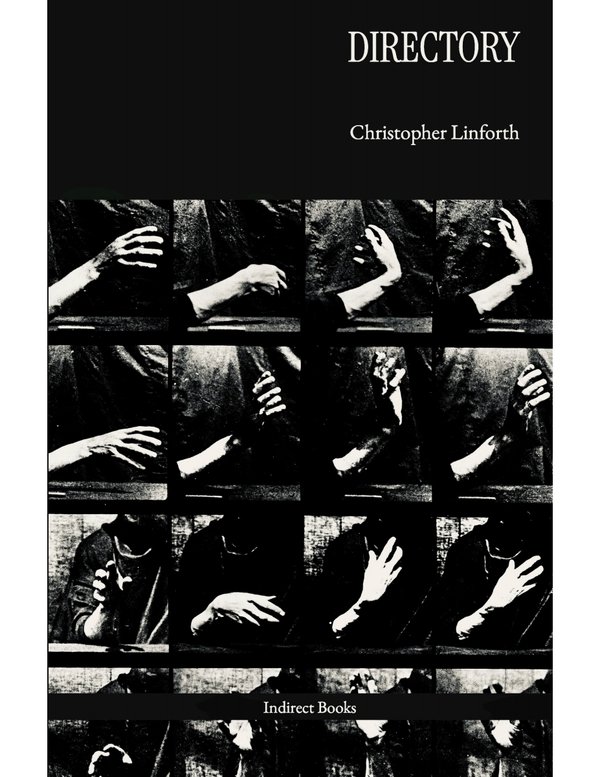
Directory
By Christopher Linforth
Indirect Books
Published October 20, 2026


